
Putin Seeks Stronger Russian Influence in Africa as Leaders Weigh Their Options
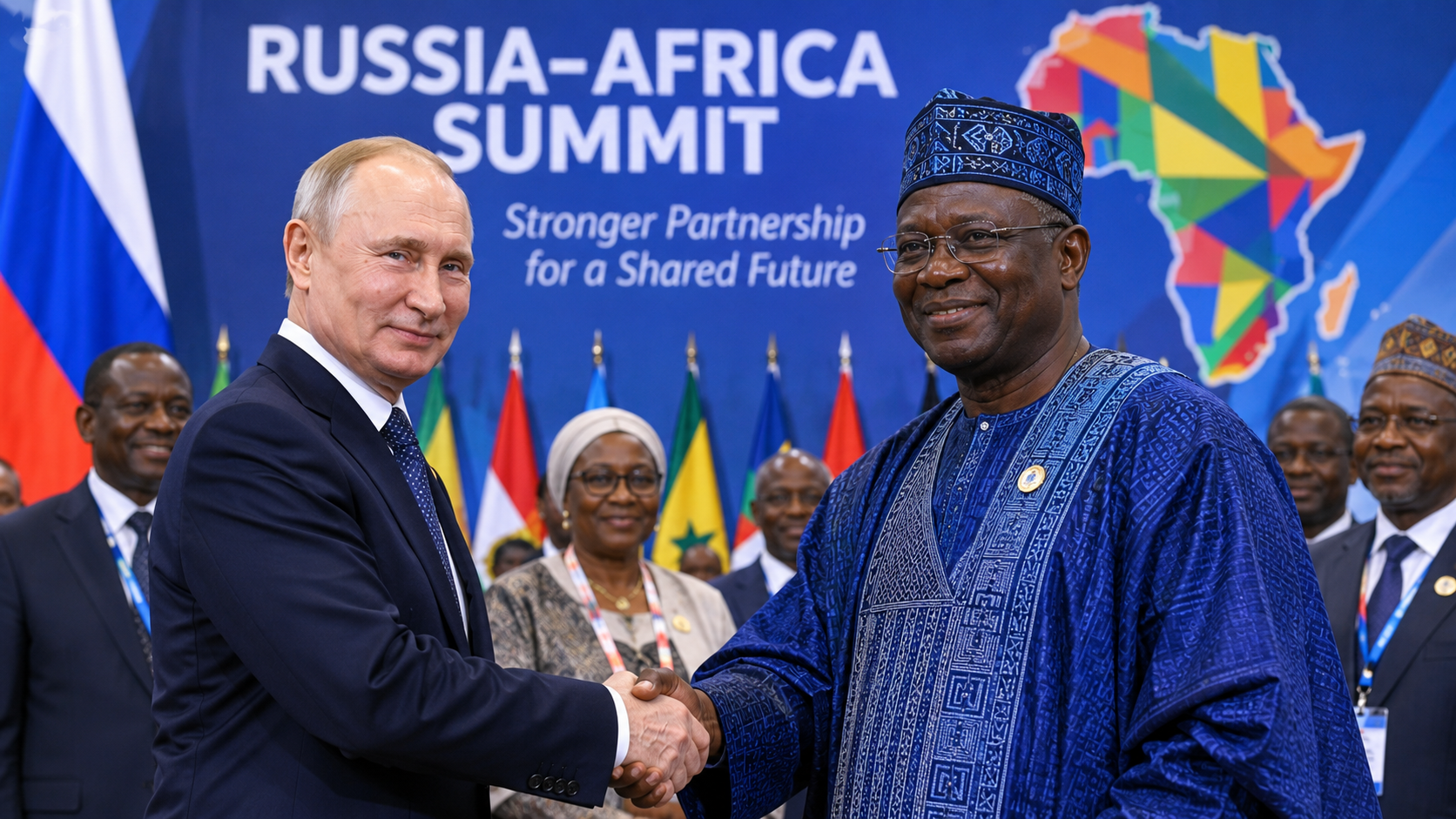
Russian President Vladimir Putin is seeking to strengthen Moscow’s position across Africa as the Kremlin expands its international partnerships while facing continued Western sanctions over the war in Ukraine.
The third Russia-Africa Summit, held in Moscow on 28 and 29 October, brought together delegations from 48 of Africa’s 54 countries. Twenty-two countries were represented by their heads of state, according to the Kremlin. The gathering provided Putin with an opportunity to present Russia as an alternative partner to Western governments and promote closer cooperation in trade, technology, security and development.
Putin accused Western countries of exploiting African resources, maintaining colonial-era relationships and using debt to restrict development. He argued that Russian businesses offered a different approach through investment, technology transfers and local job creation. He also said trade between Russia and African countries exceeded $27 billion in 2025, while setting a target of increasing it beyond $50 billion.
However, African governments are not necessarily choosing Russia over Europe or the United States. Analysts describe their approach as diversified non-alignment, allowing countries to maintain relationships with multiple international partners while pursuing their own economic and political priorities. The summit also gives African leaders an opportunity to negotiate better terms with established partners as global competition for the continent’s resources and influence increases.
Energy, agriculture and technology featured prominently in discussions. Russia’s state nuclear company, Rosatom, is building Egypt’s El Dabaa nuclear power plant, while Moscow has promoted further cooperation in civilian nuclear energy, artificial intelligence and pharmaceutical production. Putin also highlighted Russian grain deliveries to Africa, saying the country supplied more than 18 million tonnes last year. Turning these commitments into lasting projects will depend on investment, infrastructure and local expertise.
Military cooperation remains another important part of Russia’s relationship with the continent. Ethiopian Prime Minister Abiy Ahmed said Ethiopia had received Russian Su-35 fighter jets and planned to acquire four S-400 air-defence systems. The aircraft agreement covers 12 jets, with Russia’s state arms exporter confirming that two had been delivered. The arrangement demonstrates Moscow’s continuing role as an arms supplier despite sanctions, although concerns remain about regional security implications.
The expansion of military links has also raised concerns about the recruitment of African nationals into Russia’s war against Ukraine. Amnesty International has documented cases in which Africans were allegedly recruited through deception, coercion or economic hardship. CNN also interviewed men who said they had been misled or forced into Russian military service. Russia has denied involvement in unlawful recruitment, maintaining that foreign nationals can voluntarily enlist in its armed forces.
The summit concluded with a joint declaration, an agreement on civilian artificial intelligence and a Russia-Africa cooperation action plan covering 2027 to 2029. Russia and the African Union Commission also agreed on a framework covering security, trade, energy, agriculture, healthcare, education and technology. The commission has clarified that the framework is not legally binding, leaving implementation dependent on funding, institutional responsibilities and measurable progress.
Putin’s efforts underline Moscow’s ambition to maintain and expand its international influence despite its confrontation with Western governments. Yet African leaders are pursuing a broader strategy, using relationships with Russia and other global powers to advance national interests. Whether the latest agreements deliver meaningful economic and social benefits will depend on what happens beyond the diplomatic commitments made in Moscow.
For further local news, community updates and story tips, contact news@lakelandpost.co.uk or 0333 090 2080.