
UK Government Announces Sweeping Social Media Ban for Under-16s
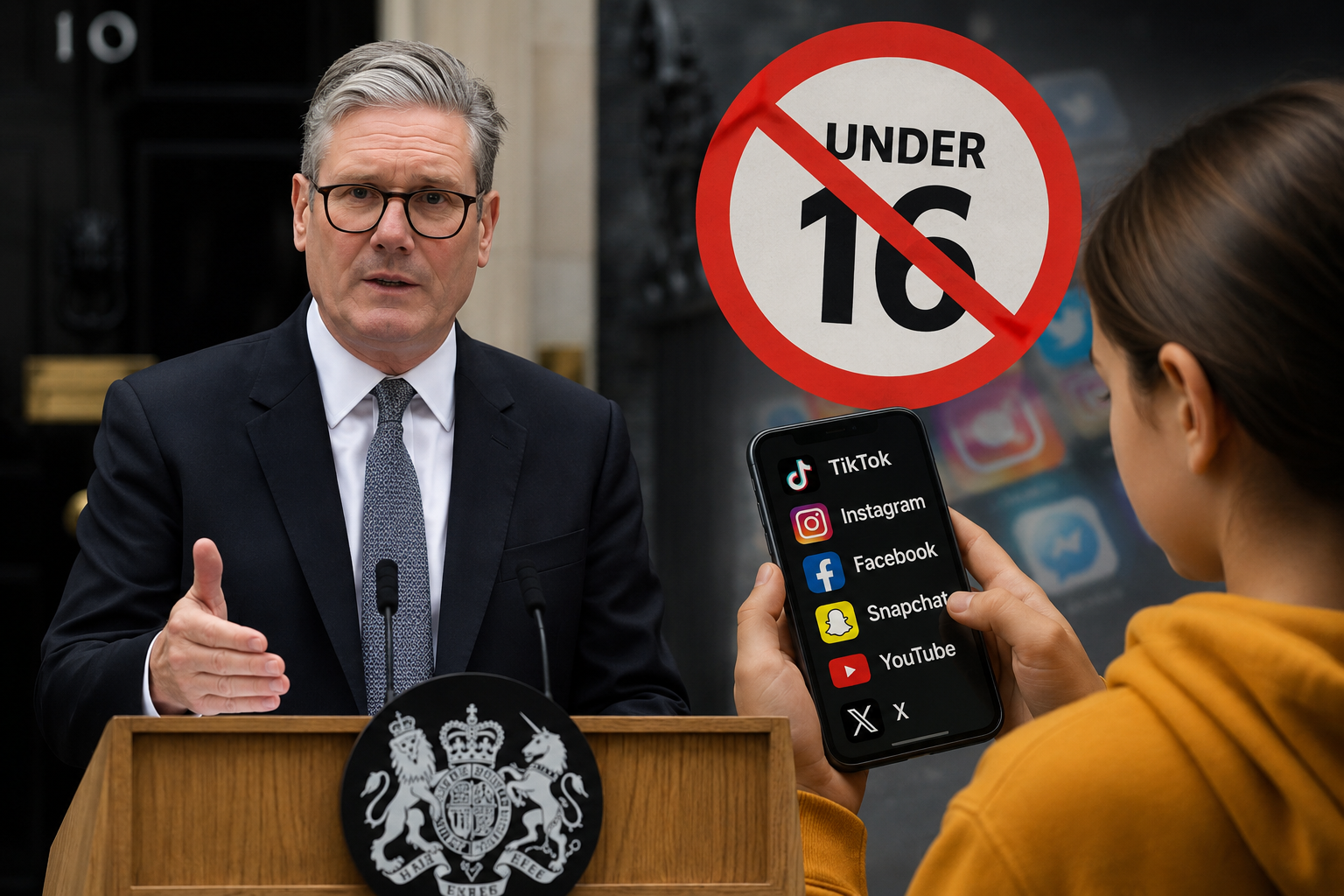
UK Prime Minister Keir Starmer has announced one of the most significant online safety measures in the country’s history, revealing plans to ban children under the age of 16 from using major social media platforms.
The proposed restrictions are aimed at reducing children's exposure to harmful content, cyberbullying, online exploitation, and addictive digital features that experts say can negatively affect mental health and development.
Under the government's proposal, popular platforms including TikTok, Instagram, Facebook, Snapchat, YouTube, and X would be required to prevent users under 16 from accessing their services. Messaging applications such as WhatsApp and Signal would not be included in the ban. The government is also considering additional safeguards that would limit interactions with strangers, restrict livestreaming features, and impose tighter controls on artificial intelligence-powered chatbots aimed at young users.
Speaking at a Downing Street press conference, Starmer argued that the measure is designed to put children's wellbeing ahead of commercial interests. He said that online platforms have become environments where young people face bullying, abuse, manipulation, and constant pressure, and that stronger protections are urgently needed. The prime minister stressed that responsibility for enforcing the rules would fall on technology companies rather than children or parents.
The government intends to introduce the necessary legislation before the end of the year, with implementation expected during the early months of next year. Officials believe the policy will create a safer digital environment while encouraging technology firms to improve age verification systems and strengthen protections for younger users.
The announcement has drawn mixed reactions from stakeholders. Child protection organizations welcomed the decision, describing it as a major victory for online safety campaigners who have spent years calling for stronger regulations. Supporters argue that social media companies have failed to adequately protect children from harmful content and addictive platform designs.
However, critics have questioned whether a blanket ban is the most effective solution. Human rights advocates and some opposition figures argue that the focus should be on forcing companies to make their platforms safer rather than excluding children entirely. Concerns have also been raised about enforcement challenges, with some experts suggesting that young users may attempt to bypass restrictions through virtual private networks (VPNs) or other technological workarounds.
Technology companies have also pushed back against the proposal. Representatives from major platforms argue that they have already invested heavily in age-appropriate experiences and safety tools. They warn that banning young people from mainstream services could unintentionally drive them toward less regulated and potentially more dangerous online spaces.
The proposal places the United Kingdom among a growing number of countries seeking tougher regulation of children's online activity. As lawmakers prepare to debate the measure, the initiative is expected to become a major political and social issue, raising broader questions about digital rights, parental responsibility, and the role of governments in regulating online platforms.
If approved, the legislation could fundamentally reshape how young people access the internet and may serve as a model for similar policies in other countries.
Got a news story or tip to share? Contact our editorial team by emailing news@lakelandpost.co.uk or call us directly on 0333 090 2080.