
New Supercomputer Simulation Recreates First Two Billion Years Of The Universe
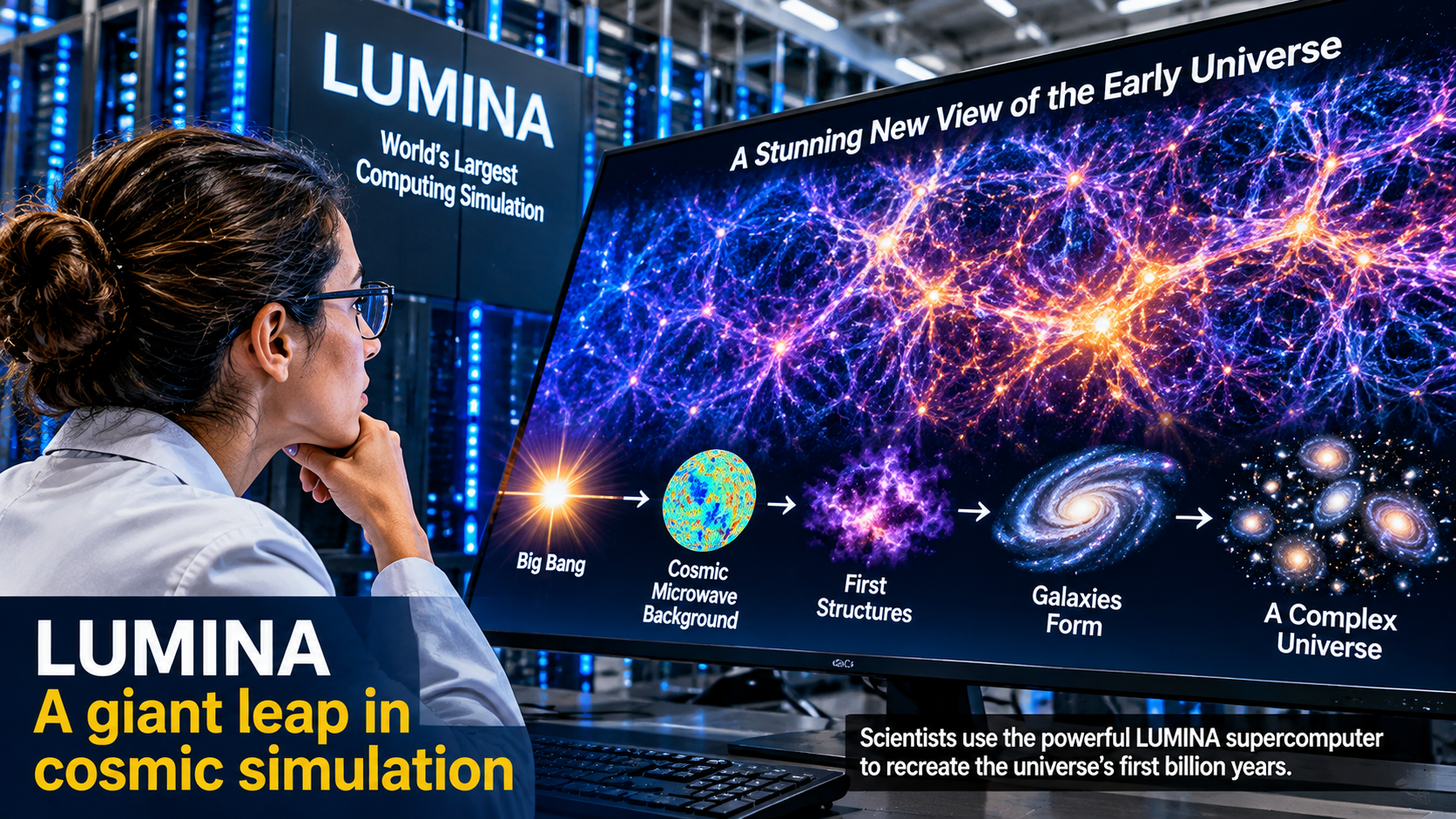
Scientists have developed a powerful new computer simulation that offers an unprecedented look at the early universe, helping researchers understand how the first stars, galaxies and black holes transformed the cosmos.
The simulation, named Lumina, has been developed by an international research team and recreates the evolution of the universe during its first two billion years. Published in the scientific journal Monthly Notices of the Royal Astronomical Society, the research provides a detailed model of how ordinary matter, dark matter and radiation interacted as the earliest cosmic structures began to emerge. Researchers hope it will help explain some of the biggest unanswered questions about the origins and development of the universe.
One of the central features of Lumina is its ability to model reionisation, an important period when the universe gradually became more transparent to light. Following the Big Bang, the cosmos contained large quantities of neutral hydrogen, which prevented light from travelling freely through space. As the first stars and galaxies developed, they produced ultraviolet radiation powerful enough to strip electrons from hydrogen atoms, changing the conditions across vast regions of the universe. This transformation helped bring the early cosmic dark ages to an end.
The simulation also examines the role of helium, the second most abundant element in the universe. While early stars and galaxies played a major role in hydrogen reionisation, the researchers found that highly energetic radiation from active supermassive black holes was responsible for driving helium reionisation. Lumina is particularly significant because it allows scientists to investigate the evolution of both hydrogen and helium within a single model, providing a more comprehensive picture of the processes that shaped the early cosmos.
The scale of the project is another major achievement. Lumina covers a region approximately 500 megaparsecs across, equivalent to around 1.6 billion light-years in each direction. This represents more than 100 times the volume covered by previous comparable simulations. Despite its enormous scale, the model can also examine individual developing galaxies, allowing researchers to study both the large-scale structure of the universe and the smaller processes responsible for galaxy formation.
Producing such a detailed model required an extraordinary amount of computing power. The research team used Frontier, a powerful supercomputer based at Oak Ridge National Laboratory in Tennessee. The calculations took nearly three years to complete and involved more than 15,000 graphics processing units at peak operation. The simulation processes approximately half a trillion individual elements, including dark matter particles and gas cells, making it one of the most computationally demanding projects of its kind.
Lead researcher Oliver Zier, a postdoctoral research fellow at the Center for Astrophysics at Harvard and Smithsonian, said the model provides an opportunity to examine how galaxies are distributed across the cosmic web while still resolving individual galaxies. Its large coverage allows scientists to investigate regions that smaller simulations might overlook, including rare galaxies and differences in how separate parts of the universe evolved.
The project could also help researchers investigate the relationship between ordinary matter and dark matter. Ordinary matter makes up stars, planets and everything visible around us, while dark matter is an invisible substance that influences the universe through gravity. The two behave differently when interacting with radiation, creating large-scale patterns that can help explain how galaxies and other cosmic structures developed. Simulations such as Lumina allow scientists to investigate these patterns in ways that are difficult to achieve through telescope observations alone.
Researchers believe the model will become particularly valuable when compared with observations from powerful space telescopes, including NASA's James Webb Space Telescope and future astronomical observatories. By comparing simulated galaxies with real observations, scientists can test existing theories about cosmic evolution. If the models fail to match what telescopes discover, those differences could reveal missing elements in current scientific understanding and point towards new areas of research.
The Lumina research represents an important development in efforts to understand the universe's earliest history. Although the simulation covers an enormous region of space, researchers acknowledge that it represents only a small part of the entire universe. Its findings are expected to provide a valuable foundation for future investigations into galaxy formation, black holes, dark matter and the physical processes that transformed the cosmos after the Big Bang.
For further local news, community updates and story tips, contact news@lakelandpost.co.uk or 0333 090 2080.