
SpaceX Starship Completes Historic Return To Texas With First-Ever Tower Catch
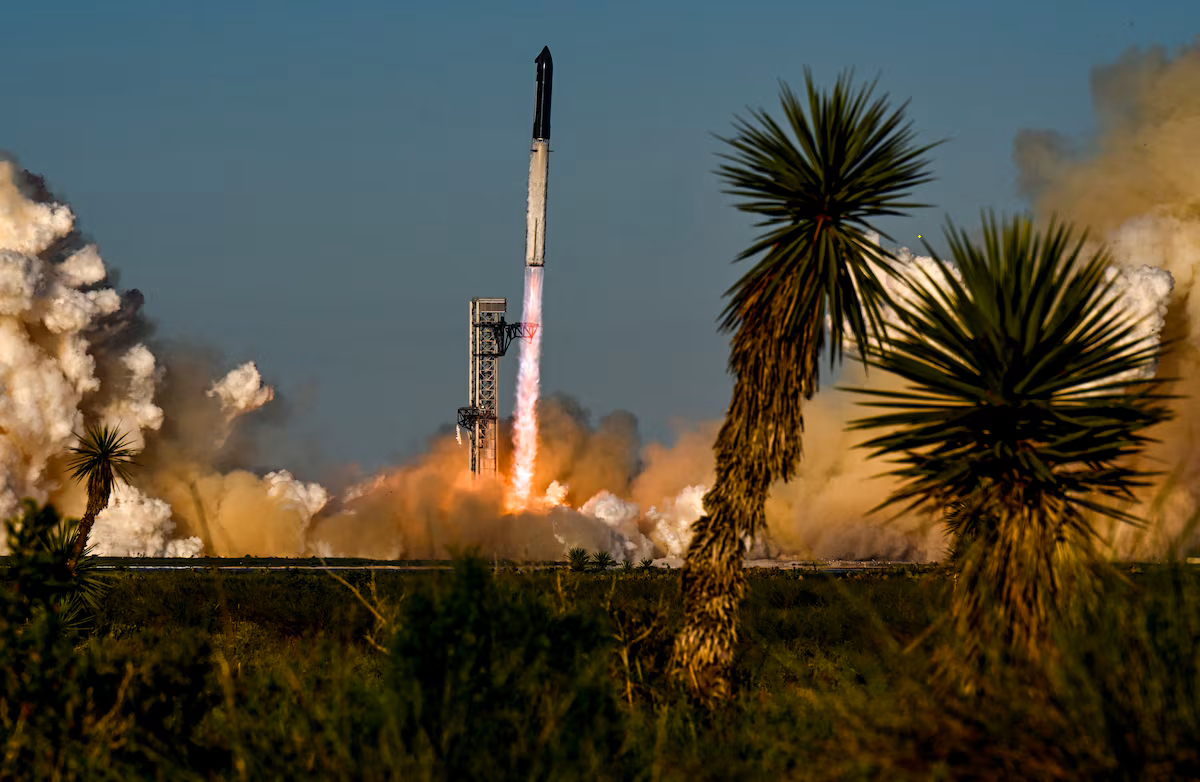
SpaceX has achieved a major milestone in reusable rocket technology after its Starship spacecraft returned from orbit and was caught at its Texas launch site.
The successful recovery took place on Saturday, November 14, following the rocket's 15th test flight. The spacecraft spent approximately 22.5 hours in space, completing 14 orbits around Earth before returning to Starbase in South Texas. It was the first time SpaceX had successfully brought the Starship upper stage back to its launch tower using the facility's giant mechanical arms, known as the chopsticks.
The mission began on Friday, November 13, when the two-stage Starship rocket lifted off from SpaceX's Starbase facilities. Its Super Heavy booster powered the spacecraft through the initial stages of flight before separating and beginning its own return journey. The upper stage continued towards orbit, carrying out the mission objectives before preparing for its planned return to Earth.
However, the booster recovery did not go according to plan. Super Heavy was unable to return to the launch tower after an onboard issue interrupted its planned flight path. It was diverted towards the Gulf of Mexico, where it exploded shortly before reaching the water. This meant SpaceX could not complete its intended recovery of both rocket stages during the same mission.
Despite the setback, the Starship spacecraft continued its journey successfully. During the mission, it deployed 26 upgraded Starlink satellites into orbit, adding to SpaceX's satellite network. The deployment demonstrated the vehicle's ability to carry payloads into space while continuing to test its systems over an extended orbital flight.
After completing 14 circuits of Earth, Starship began its return by carrying out a controlled de-orbit manoeuvre. The spacecraft then entered Earth's atmosphere at a speed of approximately 17,000 miles per hour, facing extreme temperatures as it descended towards the Texas coast.
The vehicle used its heat shield and aerodynamic control systems to manage the intense conditions of re-entry. Its black hexagonal heat-shield tiles are designed to protect the spacecraft from the extreme heat generated as it travels through the atmosphere. SpaceX has been working to improve the design so that the vehicle can be reused with less maintenance between flights.
As Starship approached the launch site, it reignited three of its engines to turn into an upright position and control its final descent. The launch tower's two large mechanical arms then moved into position and successfully caught the spacecraft as it hovered above the landing area. The manoeuvre marked the first successful tower recovery of a Starship upper stage.
The achievement represents an important step in Elon Musk's long-term ambition to develop a rocket system that can be reused frequently, in a similar way to commercial aircraft. Unlike conventional launch vehicles that discard major components after a mission, Starship is being designed to return both its upper spacecraft and lower booster for potential refurbishment and another flight.
SpaceX has already demonstrated the recovery of its Super Heavy booster on previous test flights, using the same mechanical-arm system. However, recovering the upper Starship vehicle presents a different technical challenge because it travels into orbit and must withstand the extreme conditions of atmospheric re-entry before returning to the launch site.
The latest test also demonstrated the progress made since earlier Starship missions. The company has spent more than $15 billion developing the programme, which it sees as central to its future launch operations, satellite business and ambitions for human space exploration. The successful return provides further evidence that the spacecraft can complete a controlled orbital journey and reach its original launch location.
Nevertheless, significant engineering challenges remain. The failed booster recovery means SpaceX has yet to demonstrate the successful return of both stages during a single mission. The heat shield also requires further development before the spacecraft can be reused regularly without extensive inspection and refurbishment.
The programme is particularly important for NASA's plans to return astronauts to the Moon. The space agency has committed approximately $3.2 billion towards a Starship development contract worth more than $4 billion. A modified version of the spacecraft is intended to support future Artemis lunar missions, with NASA targeting crewed lunar flights beginning in 2028.
One of the major requirements for those missions will be demonstrating the transfer of fuel between spacecraft in orbit. Starship will need to refuel in space before undertaking longer journeys, including missions to the Moon. This capability has not yet been fully demonstrated and remains among the important technical milestones facing the programme.
SpaceX also sees Starship as a potential platform for expanding its satellite operations and supporting future orbital infrastructure. Its larger payload capacity and planned reusability could allow the company to launch more equipment and satellites while reducing the cost associated with individual missions.
The successful Texas recovery has therefore provided SpaceX with an important achievement, even though the overall test did not meet every objective. The company will need to address the booster recovery issue, improve heat-shield durability and demonstrate further operational capabilities before Starship can become a regularly reusable launch system.
For further local news, community updates and story tips, contact news@lakelandpost.co.uk or 0333 090 2080.