
FTSE 100 Falls To 10,673 As AI Fears, Higher Interest Rates And Housing Weakness Hit Markets
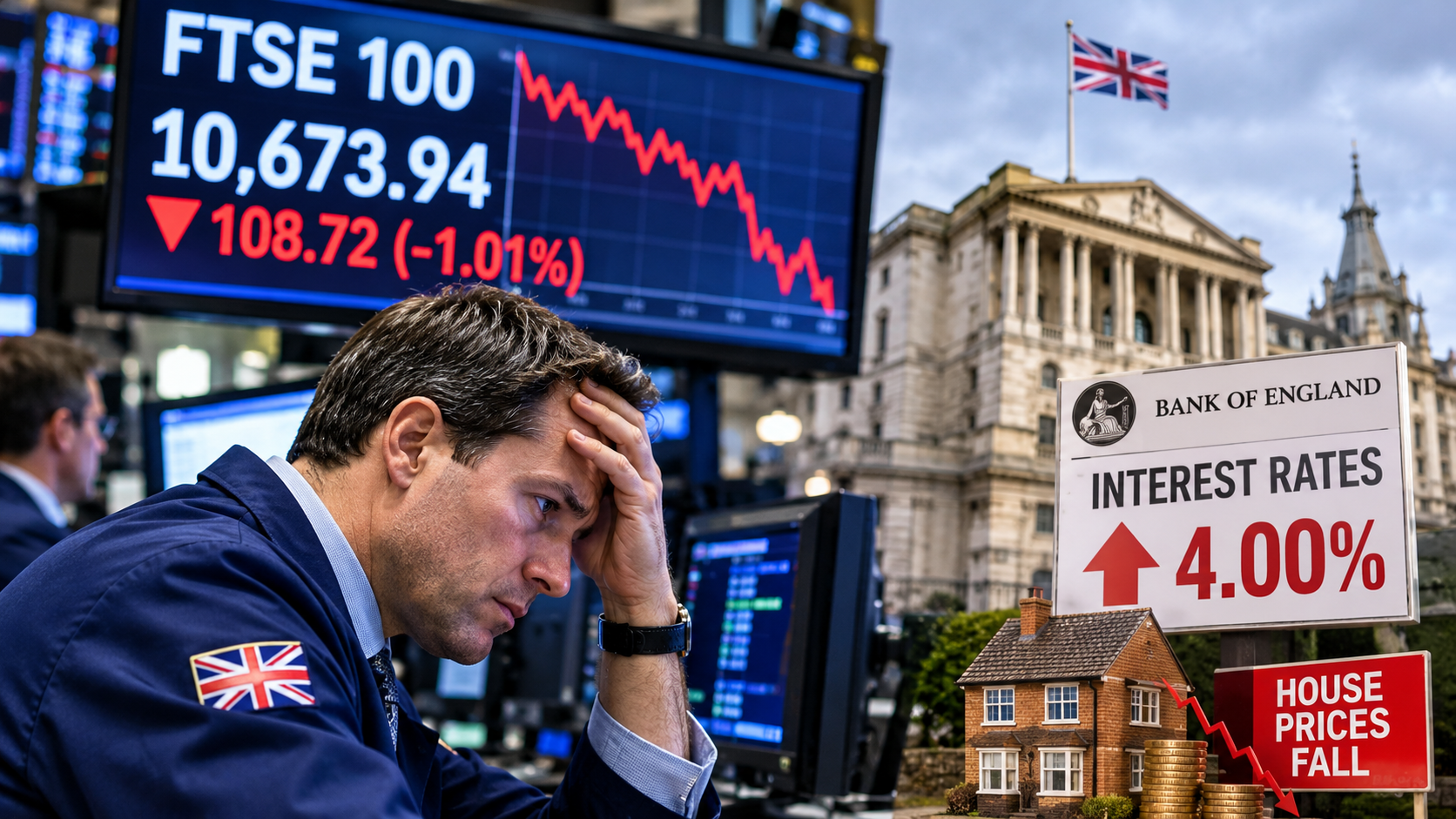
The FTSE 100 fell by more than 100 points on Friday as artificial intelligence concerns and mounting economic pressures unsettled financial markets.
London’s leading share index closed at 10,673.94 points, down 108.72 points or 1.01 per cent. It had fallen further during the session, briefly reaching 10,528.07, its lowest level in more than three weeks. The decline left the FTSE 100 down 0.5 per cent over the week, reflecting a wider retreat in global equities as investors reassessed the outlook for technology companies and the scale of spending on artificial intelligence.
The FTSE 250, which tracks medium-sized UK-listed companies, also came under pressure. It fell 0.80 per cent on Friday to 24,504.32 points, although it managed to record a small gain across the week. The broader weakness reflected caution among investors, with selling extending beyond the largest technology-related businesses and affecting several major sectors.
The immediate pressure came from a sharp sell-off on Wall Street on Thursday. US technology shares suffered heavy losses amid concerns about the commercial returns from artificial intelligence investment and the possibility of tighter regulation. The Nasdaq Composite dropped 5.5 per cent, while the S&P 500 fell 4.4 per cent and the Dow Jones Industrial Average lost 3.4 per cent. The Nasdaq’s decline was its steepest since April 2025.
Political developments in the United States also contributed to investor uncertainty. Democratic gains in the midterm elections raised questions about the future regulatory environment for artificial intelligence and the pace of data centre construction. Investors are increasingly weighing whether major technology businesses will continue spending heavily on infrastructure or face pressure to demonstrate stronger financial returns from their investments.
Those concerns crossed the Atlantic and affected European markets. The STOXX 600, a broad European share index, ended Friday around one per cent lower. In London, most sectors recorded declines, showing that the pressure was not confined to technology-related businesses. Precious metal miners were among the few areas to make gains, rising by 1.7 per cent.
Telecommunications shares were among the weakest performers in the FTSE 100, with the sector falling 3.6 per cent. BT Group lost 6.4 per cent, while Airtel Africa fell four per cent. Energy stocks also declined as oil prices weakened, leaving the sector down 1.6 per cent. The falls demonstrated how concerns about the global economic outlook and changing investor expectations were affecting a wide range of listed companies.
The market downturn came after the Bank of England raised its base interest rate by 0.25 percentage points to four per cent on Thursday. It was the first increase in more than three years, marking a shift in monetary policy as policymakers respond to persistent inflationary pressures. The decision adds to the financial pressure facing households and businesses already dealing with higher borrowing costs.
The Bank’s decision was influenced by concerns that inflation could remain elevated. Inflation stood at 3.5 per cent in September, and the Bank warned that it could rise to around 4.9 per cent next summer if energy prices remain high. Governor Andrew Bailey indicated that another increase could be possible, although he stressed that further rises were not inevitable and would depend on how the economic situation develops.
Higher interest rates are particularly significant for households with mortgages and people hoping to buy property. More expensive borrowing can reduce affordability, weaken demand and make it harder for homeowners to refinance. The effects can also spread into the wider economy as households have less disposable income to spend on goods and services.
Fresh housing figures added to the concerns. Lloyds reported that British house prices fell in October at their fastest annual pace in a year, with higher mortgage costs weighing on demand. The figures provided another indication of the pressure facing the property market as borrowing became more expensive. A sustained decline in prices could also affect household confidence and activity across the housing sector.
The combination of falling share prices, higher interest rates and weakness in housing has created a challenging environment for UK investors. However, the movements in the FTSE 100 reflect several overlapping influences rather than a single cause. International technology-sector concerns drove much of Friday’s market retreat, while domestic monetary policy and housing conditions added to the wider uncertainty.
Despite the difficult session, the FTSE 250 recorded a small weekly gain, suggesting that performance across the UK market was not uniformly negative. Investors will now be watching economic data, company results and developments in artificial intelligence regulation for signs of whether the recent sell-off will continue or confidence will begin to recover.
For further local news, community updates and story tips, contact news@lakelandpost.co.uk or 0333 090 2080.