
FTSE 100 Surges 109 Points as Investors Return to London Shares
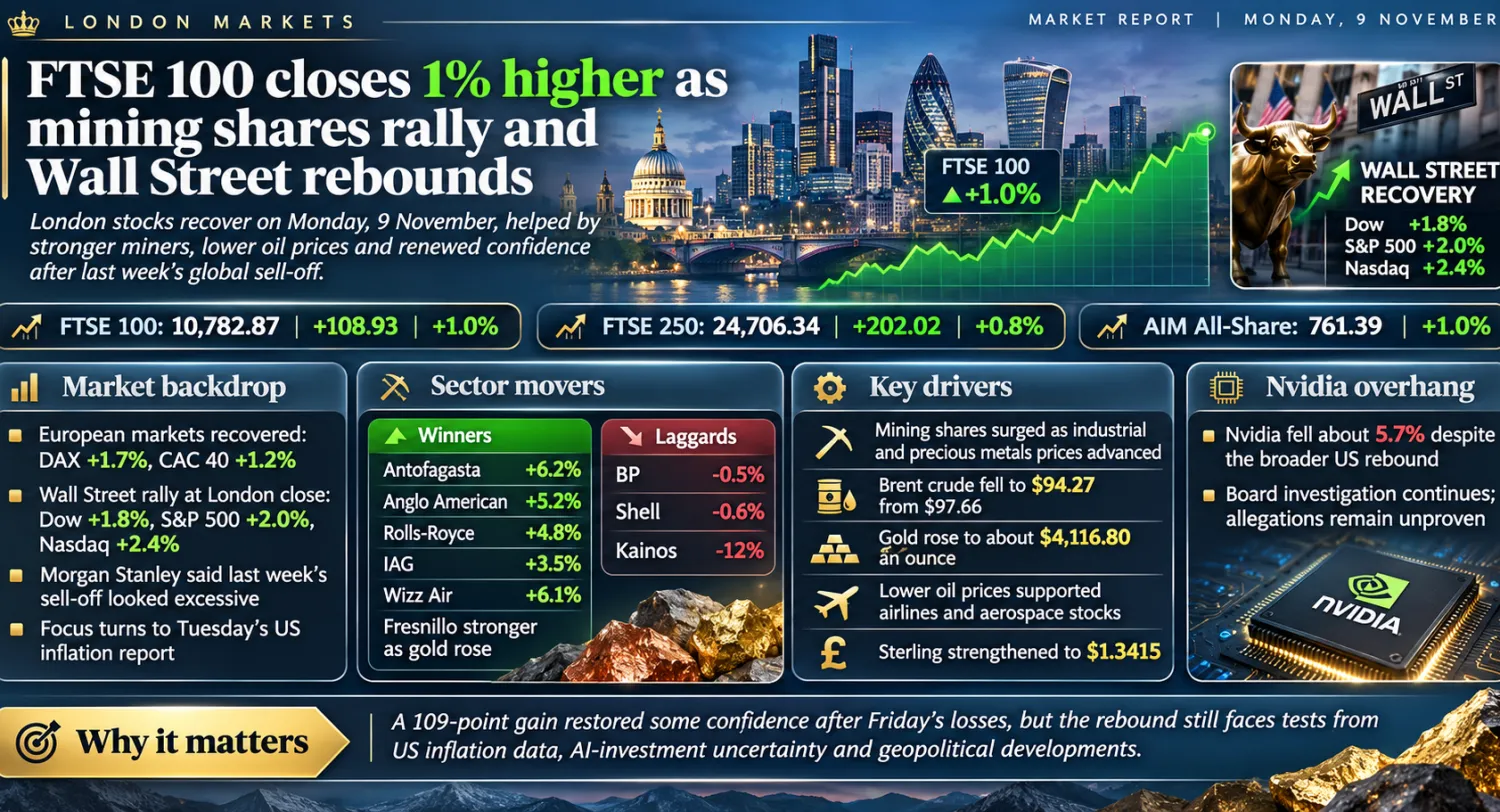
London’s leading share index climbed on Monday as investors returned to equities following last week’s sharp global market sell-off, supported by stronger international sentiment.
The FTSE 100 closed 108.93 points higher, representing a 1 per cent increase, at 10,782.87. The recovery followed a difficult period for global markets, when concerns about artificial intelligence investment, expensive technology valuations and possible regulatory changes triggered widespread selling. The FTSE 250 also advanced, gaining 202.02 points, or 0.8 per cent, to finish at 24,706.34. The AIM All-Share rose by approximately 1 per cent to 761.39, indicating that the improvement extended beyond Britain's largest listed companies.
The rebound was supported by a stronger performance on Wall Street. Around the time London trading ended, the Dow Jones Industrial Average was up 1.8 per cent, the S&P 500 had gained 2 per cent and the Nasdaq Composite was trading 2.4 per cent higher. The recovery helped improve confidence after technology-related shares had experienced considerable pressure during the previous week. Investors appeared more willing to consider buying opportunities, although concerns about future technology spending and the wider economic outlook remained.
Mining companies were among the strongest performers in London, benefiting from firmer industrial metal prices and renewed demand for shares linked to commodities. Antofagasta advanced 6.2 per cent to 3,305p, while Anglo American gained 5.2 per cent to 3,894p. Fresnillo also recorded a substantial increase, rising to 2,638p. These gains provided important support for the FTSE 100, reflecting the influence of mining companies on the benchmark index and investors' continued interest in metals producers.
Gold prices also moved higher during the session, reaching approximately $4,116.80 an ounce, compared with $4,058.03 on Friday. The increase supported sentiment towards precious metal producers, including companies with significant exposure to gold and silver. Investors were assessing movements in the US dollar, bond yields and geopolitical developments when making decisions about safe-haven assets. The stronger gold price added to the positive performance across parts of the mining sector, although commodity prices remain sensitive to changes in international economic conditions.
Falling oil prices provided another source of support for the market. Brent crude traded at around $94.27 a barrel, down from $97.66 at the end of the previous week. Investors were responding to signs that diplomatic discussions involving the United States and Iran could offer a route towards reducing tensions. Lower oil prices can ease operating costs for fuel-intensive industries and reduce some inflationary pressure, although the outlook remains dependent on developments in the region and the wider energy market.
Airlines and aerospace businesses benefited from the combination of lower oil prices and improved investor confidence. International Airlines Group, the owner of British Airways, gained 3.5 per cent, while Rolls-Royce rose 4.8 per cent. Melrose Industries also advanced by 3.3 per cent. Lower fuel costs can improve the financial outlook for airlines, while greater geopolitical stability may support international travel and business activity. The gains reflected renewed interest in companies that had been exposed to concerns about energy costs and global uncertainty.
The positive movement extended to the FTSE 250, where budget airline Wizz Air climbed 6.1 per cent. Technology-related company Raspberry Pi also gained 4.6 per cent as investors returned to selected growth stocks. However, the recovery was not universal. Kainos Group fell sharply, losing 12 per cent after publishing its half-year financial results. The contrasting performances demonstrated that investors were still assessing individual company results carefully, rather than buying shares across every sector indiscriminately.
Kainos reported stronger revenue and earnings for the first half of its financial year and maintained its full-year guidance. However, investors were concerned about a decline in gross margin to 43.1 per cent, compared with 48 per cent previously. The company attributed the reduction mainly to greater use of contractors and external partners to deliver larger projects. Although this approach can help secure higher-value contracts, it generally produces lower margins than work completed by the company's own employees.
The company's strategy involves taking on larger contracts while using external partners to increase delivery capacity. Kainos indicated that these arrangements can reduce gross margins but may create opportunities to secure contracts with higher overall values. Nevertheless, the market reaction suggested that investors wanted clearer evidence that the strategy would translate into sustainable profitability. AJ Bell Investment Director Russ Mould highlighted concerns about the margin pressure and the company's outlook, adding to the negative reaction following the results.
Nvidia remained another focus for international investors despite the broader recovery in technology shares. Its stock fell approximately 5.7 per cent amid reports concerning chief executive Jensen Huang and an investigation into allegations involving a business executive linked to Singapore-based data centre company Megaspeed International. Huang acknowledged an extramarital affair and apologised to his family and colleagues. Nvidia's board said it had no reason to believe company secrets or US national security information had been compromised. The allegations remain subject to scrutiny, and the investigation's findings have not been established.
Currency markets also reflected the changing mood among investors. Sterling strengthened against the US dollar, reaching approximately $1.3415 compared with $1.3362 late on Friday. Against the euro, however, the pound slipped to around €1.1974. The euro strengthened to $1.1203, while the dollar weakened against the Japanese yen to approximately ¥158.05. Movements in currencies can affect the international earnings of major UK-listed companies, particularly those with substantial overseas operations and revenue denominated in foreign currencies.
Bond markets remained relatively steady during the session. The yield on the US 10-year Treasury note increased slightly to 4.88 per cent from 4.87 per cent on Friday, while the 30-year yield rose to 5.27 per cent from 5.26 per cent. Investors were also preparing for the release of US inflation figures, which could influence expectations for future Federal Reserve interest rate decisions. Economic data and central bank policy remain important considerations for equity valuations, borrowing costs and the direction of international investment flows.
The next trading sessions are expected to be influenced by economic announcements and company updates. China's latest trade figures and US inflation data were among the developments attracting attention on Tuesday. In the UK corporate calendar, investors were also preparing to assess Vodafone's half-year results and a trading update from Watches of Switzerland. Monday's advance offered some relief after a difficult week, but questions surrounding technology investment, geopolitical tensions, commodity prices and interest rates continued to shape the outlook for financial markets.
For further local news, community updates and story tips, contact news@lakelandpost.co.uk or 0333 090 2080.